

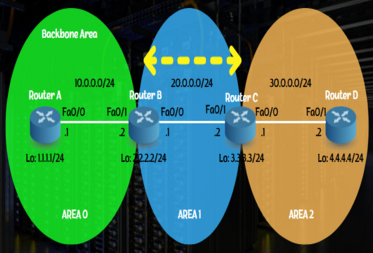
OSPF (Open Shortest Path First) is a link-state routing protocol used to exchange routing information within an autonomous system (AS), typically within an enterprise or service provider network. It's one of the most widely used interior gateway protocols (IGPs) due to its scalability and flexibility. OSPF operates within a single autonomous system, unlike BGP which operates between autonomous systems.
Here's a basic overview of how OSPF works:
- Neighbor Discovery: OSPF routers discover their neighbors and establish adjacencies by exchanging Hello packets. Hello packets are multicast periodically to discover neighbors on directly connected links.
- Topology Exchange: After neighbors are discovered and adjacencies are established, OSPF routers exchange link-state advertisements (LSAs) to describe their directly connected links and the state of those links. These LSAs are used to build a complete picture of the network topology.
- Shortest Path Calculation: OSPF routers use the received LSAs to build a link-state database (LSDB) representing the network topology. Using this LSDB, each router calculates the shortest path to every destination network within the OSPF area using the Dijkstra algorithm.
- Advertising Routes: BGP routers advertise the best paths to reach destination networks to their neighboring routers. These advertisements are sent as BGP update messages.
- Routing Table Calculation: Based on the shortest path tree calculated using the Dijkstra algorithm, OSPF routers populate their routing tables with the best paths to reach all known destination networks.
BGP is a highly scalable and flexible routing protocol, making it suitable for large-scale networks such as the Internet. It allows network administrators to implement policies for traffic engineering, load balancing, and route filtering.Configuring OSPF on a Cisco device involves several steps, including enabling OSPF, defining OSPF areas, specifying OSPF neighbors, and configuring OSPF routing policies. Here's a basic example of configuring OSPF on a Cisco router:
Router(config)# router ospf process_id
Router(config-router)# network network_address wildcard_mask area area_id
In this example:
- process_id is the OSPF process identifier, which is locally significant to the router.
- network_address is the IP address of the network to be advertised.
- wildcard_mask is the wildcard mask used to specify which interfaces participate in OSPF.
- area_id is the OSPF area to which the network belongs.
This is a very basic configuration. In a real-world scenario, you would likely add additional configurations such as specifying OSPF neighbors, configuring OSPF authentication, and tuning OSPF metrics to optimize routing behavior according to your network requirements.



Leave a comment